- Rattlesnake master - Despite having leaves like a yucca, rattlesnake master (Eryngium yuccifolium) is actually in the carrot family. It has spherical flowers that turn into long lasting seed heads, so it provides visual interest for months. I've found this at plant sales a couple times. It will show up in the faux desert garden that I'm putting together.
- Mountain mint - I knew mountain mints (genus Pycanthemum) were good plants, but here you can read about how attractive they are to pollinators. To humans, they smell nice and minty, and they have long lasting silvery bracts--a color reminiscent of sage or lavender leaves. Since half the plants I tried in the rose bed have died, I'm going to try mountain mint there as a ground cover. They're supposed to spread readily (some say too readily). I don't really believe the lore about strongly scented herbs repelling pests from roses, but we'll give it a try anyway.
- Partridge pea - I don't know if anyone deliberately plants partridge pea (Chamaecrista fasciculate, also called sensitive plant), but it's a fun native weed. This is another plant that turns out to be more attractive to pollinators than I realized. It grows well in abominable clay soil, such as the unamended soil in my yard. If you run across it, try petting the leaves and watch them close up.
- Rose mallow - This is our native hibiscus, Hibiscus moscheutos. It has huge, showy flowers. I've successfully grown it in a rain garden and in a standard flower bed that was well mulched to keep it moist. In ideal conditions it can grow so tall that it falls over, so it might benefit from being staked or grown next to a fence.
- St. John's wort - There are many species of St. John's wort (Hypericum genus), with over a dozen of them occurring in Virginia. They have vivid yellow flowers. The species discussed here, shrubby St. John's wort, is a small bush that grows well in rain gardens but can handle other conditions. While we're talking about this genus, I'll mention St. Andrew's cross (Hypericum hypericoides), another nice weed that grows well in my abominable clay soil.
- Finally, this post on Clay and Limestone lists several wildflowers that spread readily. It's a Tennessee blog, but all except the Helianthus are also Virginia natives. The Verbesina is biennial, but I think the others are perennial.
Wednesday, October 15, 2014
Great plant recommendations
I have a huge pile of plant recommendations today. (Do links come in piles? Since these are all open in consecutive tabs in my browser, maybe it's more of a train. Anyway...) All these are Virginia natives except where noted. Some are unusual and interesting looking. Other than the partridge pea, they're all perennials, which can be handy for low maintenance landscaping.

Sunday, September 14, 2014
Corporate style planting
This bed reminds me of boring, corporate plantings that one sees in grocery store parking lots, but at least it's all native and is meant to be low maintenance. See, I wasn't planning to have a bed here at all. When we someday have the funds to build a garage, this patch will be run over in the construction process. However, in the meantime we had problems with erosion because a gutter was overflowing here. My husband requested bushes to help retain the soil.
I didn't want to mess with anything complicated, so I did some research and settled on the Shamrock cultivar of inkberry holly (Ilex glabra). Inkberry is a native holly. The female plants make black colored berries in the fall. Shamrock is a smaller cultivar, growing up to 4 feet tall, which I thought worked better with the size of my porch than the species would. You can read more about it here.
This was fine until my husband hit the new inkberries with the edger. Then he requested mulch to delineate this area as a bed so he wouldn't kill the bushes. Someday the bushes will grow to fill the bed, or, as I mentioned, the whole thing will be leveled by construction. However, it looked too empty for now. This was at the peak of summer heat, but I added some heucheras and a heucherella (a Heuchera/Tiarella hybrid--these and heucheras are trendy lately and easy to find in stores). I also transplanted in some lyreleaf sage plants from the front bed, aka the lyreleaf sage nursery. As you can see, I also did a border of concrete chunks.
The whole thing will be easy to maintain and easy to get rid of. I'll need to deadhead the lyreleaf sage plants when they flower so the bed isn't overrun, and I'll pull weeds occasionally. When we no longer need the bed, the heucheras will probably transplant readily. I assume this because they're supposed to need dividing every few years anyhow. I don't mind losing the lyreleaf sages because I can easily grow a million more. I might lose the inkberries, but that will be it.
Yes, it's boring. I suppose it demonstrates that one can do any landscaping style with native plants, including boring corporate plantings. (Please keep in mind that this was an unplanned project that I had to do concurrently with building the rain garden, something that I did put a lot of time and design effort into.)
 |
| Heuchera, heucherella, and inkberry hollies. |
 |
| Heucheras, inkberry hollies, and lyreleaf sage. |
The whole thing will be easy to maintain and easy to get rid of. I'll need to deadhead the lyreleaf sage plants when they flower so the bed isn't overrun, and I'll pull weeds occasionally. When we no longer need the bed, the heucheras will probably transplant readily. I assume this because they're supposed to need dividing every few years anyhow. I don't mind losing the lyreleaf sages because I can easily grow a million more. I might lose the inkberries, but that will be it.
Yes, it's boring. I suppose it demonstrates that one can do any landscaping style with native plants, including boring corporate plantings. (Please keep in mind that this was an unplanned project that I had to do concurrently with building the rain garden, something that I did put a lot of time and design effort into.)
Wednesday, September 10, 2014
Fall plant sales (and a few links)
We're heading into the season for fall plant sales. There seem to be more native plant sales in the spring than the fall, but fall is a great time for planting, so it's worth seeking out a sale in your area. I haven't done an exhaustive search, but here are some of the upcoming sales in Virginia.
- 9/13 - Potowmack chapter of Virginia Native Plant Society (Arlington area)
- 9/14 - Loudoun Wildlife Conservancy
- 9/19-20 - Lewis Ginter Botanical Garden (Richmond area) - Some of their vendors will have native plants. I attend this sale, since it's the most conveniently located for me.
- 9/20 - Arlington Parks and Rec
- 9/20-21, 27-28 - Virginia Living Museum (Newport News area) - Maybe I'll hit this sale on the second weekend if I don't find what I want at Lewis Ginter.
- 9/27 - Northern Alexandria native plant sale
- Simply the best natives - Golden Alexander - This is a VA native plant that's supposed to be easy to grow.
- More love for native vines - Includes recommendations for ornamental vines with various desirable properties.
- OdonataCentral - Not plants, but you can find a list of Odonata (dragonflies and damselflies) species occurring in your county. Pretty cool! There are supposed to be 20 species of them in my county.
Tuesday, September 9, 2014
Reduce, reuse, recycle
When preparing for the rain garden project, I wanted to start remedying storm water runoff as far uphill as possible. On the shoulder of our driveway were several large patches of spilled concrete from when our house was built. Concrete is presumably even less permeable to water than our native clay soil is, so the concrete had to go. A sledgehammer and several hours of labor later, I had a large collection of concrete chunks. I refused to pay to dispose of them, but the stack looked kind of like a rock wall, so that gave me an idea.
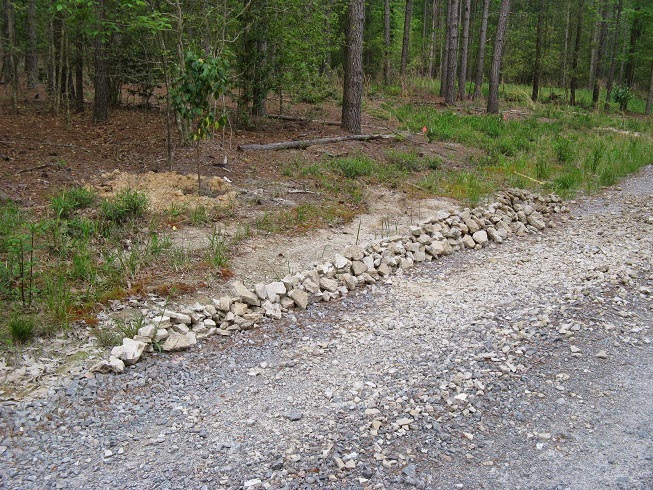 |
| Spilled concrete--now broken into chunks and pulled up from the shoulder of my driveway. |
I stacked some of the more uniformly sized concrete chunks two high, forming a small wall or border around my flower bed. I made it undulate artistically.
 |
| Faux rock wall (made from recycled concrete chunks) as a flower bed border. |
From a distance, one could easily mistake the concrete for rock. Up close, it definitely looks like concrete. So it's kind of redneck, but at least I'm not using old tires as planters. The pieces aren't mortared together, so the top layer can get knocked off by the edger, but thus far it's been quick and easy to re-stack the few pieces that fall off.
 |
| Close-up of faux rock wall (recycled concrete chunks) around flower bed. |
I've actually found the border helpful in garden design. Now that I know the exact size and shape of the bed, I can better plan how to fill it. My initial vision for the bed had straight edges, but adding the wiggles gives me some nice pockets of new space that can be filled with small plants. I was able to rip out a lot of grass that turned out to be inside the bed. Now when my husband mows the lawn, it's very clear which areas he's not supposed to cut. (I'll say more about our mowing issues in a future post.) The concrete isn't the most attractive border ever, but it was free and is useful in delineating the bed. I can always spring for fancy stones later if I want. Meanwhile, the concrete chunks can be easily moved if I decide the bed should be a different size or shape.
Saturday, August 23, 2014
Link roundup - Small shrubs, small trees, and wood poppies
"Small" is the theme of recent blog posts I've encountered. Are you looking for a small native shrub or tree, perhaps to encourage wildlife in a suburban garden?
- Native shrubs for small gardens - This lists some smaller cultivars of US native shrubs. Winterberry holly, ninebark, and Leucothoe are VA natives, and we also have various VA native blueberry and St. John's wort species.
- 10 petite trees for your landscape: Under 25 feet - Not cultivars, this time, but small tree species. Red buckeye, painted buckeye, Canadian serviceberry, Eastern redbud, alternateleaf dogwood, silky dogwood, Carolina buckthorn, and American plum are all VA natives. (Is anyone else amused that we are given the complete taxonomy for these species, starting with the fact that they are in the plant kingdom?)
- Wood poppy - What a beautiful native woodland flower. Brenda Clements Jones has successfully cultivated them.
Saturday, August 9, 2014
Link roundup - Privacy screens and devil's walkingstick
Here are a couple more links of interest:
- Privacy screening in your native plant garden - This post suggests some native evergreens that don't grow excessively large.
- Giant flower, at last - I never thought of using devil's walkingstick as an ornamental near the house because it has some wicked thorns, but this person did. As she points out, it does have an attractive flower. Devil's walkingstick is blooming in my part of Virginia right now. You'll see more from me about it in the future, including some pictures of the thorns.
Sunday, August 3, 2014
Rain garden III - The plants
This is the third post in a series about my new rain garden. Click for Part I and Part II on the process and costs, respectively. And now for the part we've all been waiting for, the plants! My goal was to use all natives. I wasn't super careful to make sure that the plants are Virginia natives, but most are. At least everything is native to the central or eastern US.
The plants were grouped into two categories. First are the ones planted in the main, low lying part of the garden. These need good tolerance for large amounts of water. These photos were taken in May through July of the plants I thought were the most photogenic. I am also growing various other species not shown here.
The other type of plant I've used is supposed to tolerate drying out frequently. These are planted around the rim of the rain garden, where they are watered by incoming rain but aren't subjected to standing water.
The plants were grouped into two categories. First are the ones planted in the main, low lying part of the garden. These need good tolerance for large amounts of water. These photos were taken in May through July of the plants I thought were the most photogenic. I am also growing various other species not shown here.

 |
| Blue flag iris (Iris sp.). I'm not sure whether this is the Northern or Southern blue flag. |
 | |||||||||
| New York aster (Symphotrichum novi-belgii). |
 |
| Water hemlock (Cicuta maculata). This is highly toxic. However, it's pretty and has a longer flowering period than some of the other things I've planted. It has grown a lot already in just a couple months. |
 |
| The water hemlock has been good for attracting pollinators. Note the bee in the upper left of this photo. |
 |
| Queen of the prairie (Filipendula rubra). Despite the name, this is a Virginia native. It's supposed to grow taller than this. Maybe next year? |
 |
| Close-up of queen of the prairie. |
 |
| Shrubby St. John's wort (Hypericum prolificum). This is a small shrub with beautiful, showy flowers. |
 |
| Buttonbush (Cephalanthus occidentalis). Eventually this will make interesting flowers. For now, it's just very happy growing in the rain garden and making lots of new foliage. |
The other type of plant I've used is supposed to tolerate drying out frequently. These are planted around the rim of the rain garden, where they are watered by incoming rain but aren't subjected to standing water.
 |
| Lanceleaf coreopsis (Coreopsis lanceolata). |
 |
| I think this is some kind of verbena. I don't know how it got here, but it's pretty so I'm keeping it for now. It might be swamp verbena (Verbena hastata), which would make it a native. |
 |
| Butterfly milkweed (Asclepias tuberosa). |
 |
| Purple coneflower (Echinacea purpurea). |
Subscribe to:
Posts (Atom)