Tuesday, September 9, 2014

Reduce, reuse, recycle

This isn't about native plants per se, but I've been posting about my front flower bed here, so I'll update you on one of the recent changes.

When preparing for the rain garden project, I wanted to start remedying storm water runoff as far uphill as possible.  On the shoulder of our driveway were several large patches of spilled concrete from when our house was built.  Concrete is presumably even less permeable to water than our native clay soil is, so the concrete had to go.  A sledgehammer and several hours of labor later, I had a large collection of concrete chunks.  I refused to pay to dispose of them, but the stack looked kind of like a rock wall, so that gave me an idea.
Spilled concrete--now broken into chunks and pulled up from the shoulder of my driveway.

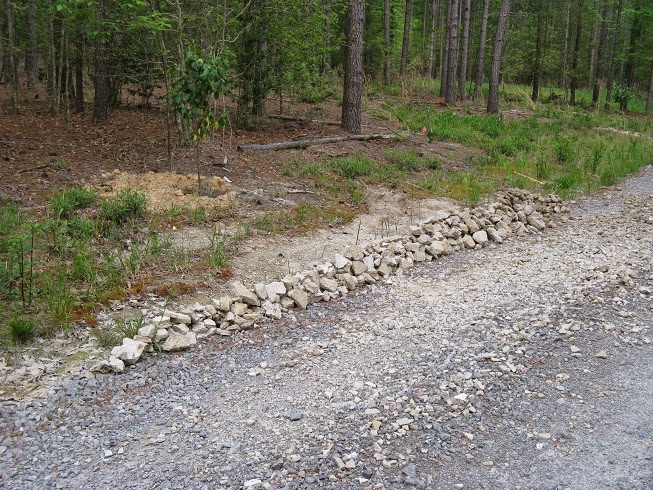
I stacked some of the more uniformly sized concrete chunks two high, forming a small wall or border around my flower bed.  I made it undulate artistically.
Faux rock wall (made from recycled concrete chunks) as a flower bed border.

From a distance, one could easily mistake the concrete for rock.  Up close, it definitely looks like concrete.  So it's kind of redneck, but at least I'm not using old tires as planters.  The pieces aren't mortared together, so the top layer can get knocked off by the edger, but thus far it's been quick and easy to re-stack the few pieces that fall off.
Close-up of faux rock wall (recycled concrete chunks) around flower bed.

I've actually found the border helpful in garden design.  Now that I know the exact size and shape of the bed, I can better plan how to fill it.  My initial vision for the bed had straight edges, but adding the wiggles gives me some nice pockets of new space that can be filled with small plants.  I was able to rip out a lot of grass that turned out to be inside the bed.  Now when my husband mows the lawn, it's very clear which areas he's not supposed to cut.  (I'll say more about our mowing issues in a future post.)  The concrete isn't the most attractive border ever, but it was free and is useful in delineating the bed.  I can always spring for fancy stones later if I want.  Meanwhile, the concrete chunks can be easily moved if I decide the bed should be a different size or shape.

Saturday, August 23, 2014

Link roundup - Small shrubs, small trees, and wood poppies

"Small" is the theme of recent blog posts I've encountered.  Are you looking for a small native shrub or tree, perhaps to encourage wildlife in a suburban garden?
  • Native shrubs for small gardens - This lists some smaller cultivars of US native shrubs.  Winterberry holly, ninebark, and Leucothoe are VA natives, and we also have various VA native blueberry and St. John's wort species.
  • 10 petite trees for your landscape:  Under 25 feet - Not cultivars, this time, but small tree species.  Red buckeye, painted buckeye, Canadian serviceberry, Eastern redbud, alternateleaf dogwood, silky dogwood, Carolina buckthorn, and American plum are all VA natives.  (Is anyone else amused that we are given the complete taxonomy for these species, starting with the fact that they are in the plant kingdom?)
  • Wood poppy - What a beautiful native woodland flower.  Brenda Clements Jones has successfully cultivated them.

Saturday, August 9, 2014

Link roundup - Privacy screens and devil's walkingstick

Here are a couple more links of interest:
  • Privacy screening in your native plant garden - This post suggests some native evergreens that don't grow excessively large.
  • Giant flower, at last - I never thought of using devil's walkingstick as an ornamental near the house because it has some wicked thorns, but this person did.  As she points out, it does have an attractive flower.  Devil's walkingstick is blooming in my part of Virginia right now.  You'll see more from me about it in the future, including some pictures of the thorns.

Sunday, August 3, 2014

Rain garden III - The plants

This is the third post in a series about my new rain garden.  Click for Part I and Part II on the process and costs, respectively.  And now for the part we've all been waiting for, the plants!  My goal was to use all natives.  I wasn't super careful to make sure that the plants are Virginia natives, but most are.  At least everything is native to the central or eastern US.

The plants were grouped into two categories.  First are the ones planted in the main, low lying part of the garden.  These need good tolerance for large amounts of water.  These photos were taken in May through July of the plants I thought were the most photogenic.  I am also growing various other species not shown here.

Blue flag iris (Iris sp.).  I'm not sure whether this is the Northern or Southern blue flag.


New York aster (Symphotrichum novi-belgii).
Water hemlock (Cicuta maculata).  This is highly toxic.  However, it's pretty and has a longer flowering period than some of the other things I've planted.  It has grown a lot already in just a couple months.
The water hemlock has been good for attracting pollinators.  Note the bee in the upper left of this photo.
Queen of the prairie (Filipendula rubra).  Despite the name, this is a Virginia native.  It's supposed to grow taller than this.  Maybe next year?
Close-up of queen of the prairie.
Shrubby St. John's wort (Hypericum prolificum).  This is a small shrub with beautiful, showy flowers.

Buttonbush (Cephalanthus occidentalis).  Eventually this will make interesting flowers.  For now, it's just very happy growing in the rain garden and making lots of new foliage.

The other type of plant I've used is supposed to tolerate drying out frequently.  These are planted around the rim of the rain garden, where they are watered by incoming rain but aren't subjected to standing water.

Lanceleaf coreopsis (Coreopsis lanceolata).

I think this is some kind of verbena.  I don't know how it got here, but it's pretty so I'm keeping it for now.  It might be swamp verbena (Verbena hastata), which would make it a native.
  
Butterfly milkweed (Asclepias tuberosa).
  
Purple coneflower (Echinacea purpurea).

Saturday, July 26, 2014

Mystery grass - Scirpus sp.?

A very striking grass is growing at my house.  It looks a lot like Scirpus cyperinus (woolgrass), which would make it a VA native.  However, woolgrass is supposed to grow in wet meadows and swamps.  This stuff grows in clay soil in medium/dry meadows and roadsides, in full to part sun.  I'm pretty sure it's in the genus Scirpus, at least.  Can anyone ID my mystery grass?

This stuff would be great as an ornamental.  It reminds me of fireworks.  I don't even like most ornamental grasses, but I took a lot of pictures of this because it looks so cool.  Also, did I mention it seems to like clay soil?

It grows in clumps and is about 5 feet tall.
It seems to be a sedge, rather than a true grass.  My father observed that the stems have a triangular cross section near the base and applied this little rhyme (which I think he learned in a college botany class in the '70s):
Sedges have edges;
rushes are round.
Grasses are hollow
like holes in the ground.


Any idea what this plant is?

Wednesday, July 16, 2014

Link roundup: Wild quinine, buttonbush, and more

I have three happy links and two depressing links.  That's an overall positive, right?  I'll put the happier ones first.
  • Native Plants and Wildlife Gardens has a post singing the praises of wild quinine, which is native to Virginia.  I haven't grown it before, but now I want to.
  • Using Georgia Native Plants talks about buttonbush, which is also native to VA.  It has an unusual flower and is great at attracting pollinators.
  • Native Plants with Adams Garden recommends surrounding your vegetable garden with a native plant border to attract pollinators.  What a clever idea, and it looks pretty too.
  • If I just stop mowing, can I get a wildflower meadow?  This post from Beautiful Wildlife Garden suggests not, since you may instead be overrun by invasive species.  However, it will depend on what grows in the surrounding areas.
  • Finally, this isn't a new article, but I ran across it on Pinterest recently.  Here are some depressing statistics on how much land in the US has been lost to human development and the negative repercussions thereof.  It makes a strong case for the importance of planting native species in one's suburban yard to promote biodiversity.

Monday, July 14, 2014

Rain garden II - The costs

Part I summarizes my rain garden construction process.  I made the mistake of not pricing out everything before beginning the project. Before you commit to a rain garden, you should probably estimate the costs by choosing your garden size, determining whether (and how much) soil will need to be replaced, and either spending a couple hours calling local companies for materials pricing (large jobs) or checking a garden supply store (small jobs).  Also, be sure to check whether your locality provides monetary help.  Your local soil conservation district is a good place to find that out.

The vast majority of our costs, and a lot of the time commitment, arose because our site was heavy clay and all the soil had to be replaced.  Our rain garden is about 220 square feet.  We dug out the clay to 3-4 feet down because soil maps indicated that this depth would hit a better draining layer of soil.  This meant we had to remove and dispose of 30 cubic yards of clay and replace it with new soil.  Disposing of clay didn't cost us directly, since we used it to build up low areas rather than having it hauled away.

The materials prices I list below are typical for my area and for the volumes I was purchasing.  Plant costs were lower because I propagated some myself and was given others for free.  Costs would be about triple if I bought everything at plant sales.

Blue flag iris bud in the rain garden.  (Picture taken in May.)
Monetary costs:
  • Mini backhoe rental, 1 weekend (including delivery/pickup) - $300
  • Replacement soil, 30 yd (incl delivery) - $1300
  • Hardwood mulch, 13 yd (incl delivery) - $400 (Only about 25% is for the rain garden itself.  50% is to help stabilize disturbed areas where we disposed of clay, and the remainder is for other projects.)
  • Grass seed and straw - $30 (For parts of yard that were disturbed and/or where we disposed of clay.)
  • Plants - $170
  • Seeds and supplies to propagate more plants - $20 (Mainly spent on small plastic pots.)
  • Satellite dish reinstallation - $100 (It was originally located in the middle of our rain garden site.)
Time:
  • Digging out 30 yd of clay with mini backhoe and moving it to roughly the right location - 13 hrs
  • Preparing locations to receive clay - 8 hrs (Removed spilled concrete from house construction, and driveway gravel that had washed into low spots.)
  • Raking clay smooth after it was dumped by backhoe - 5 hrs
  • Rearranging new soil after it was delivered - 7 hrs
  • Propagating and tending plants destined for rain garden - 6 hrs (Spread over many months so not a big deal.)
  • Internet/phone research to source equipment and materials - 3 hrs
  • Building berm on downhill side of garden - 2.5 hrs
  • Mulching garden - 1 hr
  • Planting - 4.5 hrs 
  • Repairing damage after first rainstorm - 1 hr
  • Not listed:  Book/internet research on rain gardens and plants; shopping for plants (since these were the fun/hobby parts of the project)
  • Also not listed:  Further cleanup of areas where clay was disposed (mulching, reseeding, transplanting)
Tools we used:
  • Miniature backhoe (rented)
  • Stakes, string, and spirit levels - ensuring that bottom of garden is flat and that berm/edges of garden are all at the same height
  • Shovel
  • Garden rake
  • Trowel - for planting smaller plants
  • Mulch fork
  • Work gloves - makes a huge difference in number of blisters incurred
  • Garden hose - deciding and marking perimeter of garden before digging
  • Watering can